
Want to add a touch of spice to your intimate games with bondage? Whether you're intrigued or already won over, it's best to know a few basics to avoid minor mishaps and maximize your pleasure. Between safety, complicity and sensations, this guide will give you all the keys to fully enjoy the art of bondage sessions.
To remember:
Bondage is a rope game based on trust, communication and respect for limits. Preparation, safety, constant dialogue and aftercare are the pillars of a successful session. With the right gestures and a little complicity, this practice becomes an intimate, powerful and enriching experience, accessible to all levels.
What is bondage?
Bondage is an erotic practice that consists of restricting a partner's movements. using ropes, handcuffs or other accessories. More than just a game of constraint, it's based on trust, communication and consent.
Whether it's for aesthetics, letting go or exploring sensations, bondage offers a multitude of pleasures. Accessible to novices and initiates alike, it nevertheless requires a few precautions to ensure a safe and fulfilling experience.
The different types of bondage
Bondage isn't just about "tying for tying's sake" - it's an art form! Depending on your desires, your level and the desired effect, there are a multitude of ways to bind your partner.. A brief overview of the most common styles.
- Gentle, sensory bondage: Ideal for beginners! Here, we rely on light ties, with scarves, silk ribbons or padded handcuffs. Perfect for adding a touch of sensuality without feeling totally immobilized.
- Restraint bondage: A notch higher, we seek to further restrict movement with straps, leather or solid fastenings. Wrists bound behind the back, ankles immobilized... to accentuate the game of power and submission.
- Shibari or artistic bondage: This is the haute couture of bondage! Using jute or hemp ropes, we create elegant patterns and intricate figures on the body. It's beautiful, sensual and requires a little practice.
- Suspension bondage: Expert level! Here, anchor points are used to partially or totally suspend the body. Reserved for initiates who have mastered the safety and comfort of tie-downs.
The important thing is to choose a type of link that suits you and always respects the safety and pleasure of both partners.
Preparing your session
Before jumping in with your head down (and your arms tied), take the time to prepare for your session. Bondage is above all a game of trust and shared pleasure. To avoid unpleasant surprises and maximize the experience, here are three steps not to be overlooked :
Discuss Before Practicing
Bondage is like dancing: you have to be in rhythm with your partner. Before you start, discuss your desires and limits.
- What would you like to explore today? A simple immobilization, a game of domination, a more elaborate staging?
- Is there anything you don't want to do this time? Everyone has their moods and their daily limits!
- What mood would you like to set for the session? Sensual and gentle? More intense and dominating?
Good dialogue helps avoid misunderstandings and ensures a pleasant experience for everyone.
Match Your Desires and Expectations
For a successful session, you and your partner need to be on the same wavelength.. If one is planning an intense session and the other a gentle approach, there may be a discrepancy.
- Clarify your intentions initiation, staging, new sensations?
- Respect everyone's rhythm It's all about fun and complicity, not performance.
Bondage safety rules
Pleasure, yes. But without compromising safety ! Bondage involves a certain amount of constraint, so it's essential to know and respect a few basic rules:
| ✅ Safety rule | ⚠ Explanation |
| Set a security word | If "no" is part of the game, choose an unambiguous word (e.g. "red" to stop immediately). |
| Never leave a restrained person unattended | Even for "just a minute", we don't take risks. |
| Pay attention to blood circulation | Avoid over-tightening and watch for numbness. |
| Always have a means of quick release | Keeping a pair of safety scissors handy can help avoid a stressful situation. |
| Respect emotional well-being | An intense session can sometimes arouse strong emotions. Take the time to gently return to reality after the session. |
The basics of tying your partner
Tying someone up isn't just about preventing them from moving, it's about offering them a unique sensory experience.. You don't need to master complex knots to get it right. A few well-placed ties are enough to create a real sense of constraint and excitement.
The important thing is to adapt your pressure If you're too loose, the bond doesn't hold; if you're too tight, it becomes uncomfortable. And of course, always keep an open channel of communication. Even if your partner is gagged, a nod of the head or a movement of the hand can serve as a cue. Bondage is above all an exchange, a silent dialogue between you and your partner.
The choice of material will depend on the style of bondage desired:
- Strings in jute/silk : aesthetic and sensorial.
- Handcuffs and straps : fast and convenient.
- Collars, leashes, harness : for the submissive aspect.
- Baillons and masks : to amplify the loss of control.
Above all, we need BDSM accessories safe and adapted to your level.

Bondage in Action: Tips
You're tied up or tying up, the mood is set, the game begins... But there's more to bondage than ropes and ties. To keep the experience intense and enjoyable, there are a few principles to bear in mind, even in the midst of the action.
Consent: A Constant Dialogue
If you've had a good chat before starting, that's fine. But just because everything was clear from the start doesn't mean that nothing can change along the way. Visit consentIt's not just a green light given once and for all: it's an ongoing dialogue.
An unexpected sensation, an uncomfortable position, a change in mood ? It's normal and healthy to be able to adjust the session at any time. A simple word, a look, a movement of the hand are sometimes enough to communicate. That's why it's always a good idea to set clear signals before you start, especially if speech is restricted by a gag.
Better to Stop Than Risk
You might think that asking a question in the middle of a session, or saying that a link is uncomfortable, would break the moment... but... it's better to adjust than to suffer!
If something goes wrong - a too-tight bond, discomfort, unease - express it without fear. Your partner won't be offended, quite the contrary. A successful session is one in which everyone feels good.
And if you're the one tying the knot, stay alert. A simple "Is everything all right?" whispered in the ear can reinforce intimacy and connection. Bondage is all about trust.
And let's be honest: even if a giggle, a clumsiness or a readjustment interrupts the moment, it's no big deal. What's important is mutual enjoyment and respect. A friendly atmosphere is always better than forced tension.
After the session: What to do?
Bringing Comfort
After a session, it's important to spend some time together, even if everything's gone well. Whether it's a cuddle, a glass of water, a massage or just an exchange of glances, this time of reconnection strengthens complicity and allows you to gradually return to reality.
If you are the one who tied, ask a few questions:
👉 "How do you feel?"
👉 "Did you like it? Is there anything you'd like to change next time?"
No need for in-depth analysis, but showing attention proves that the experience wasn't just a game of domination, but a genuine exchange.
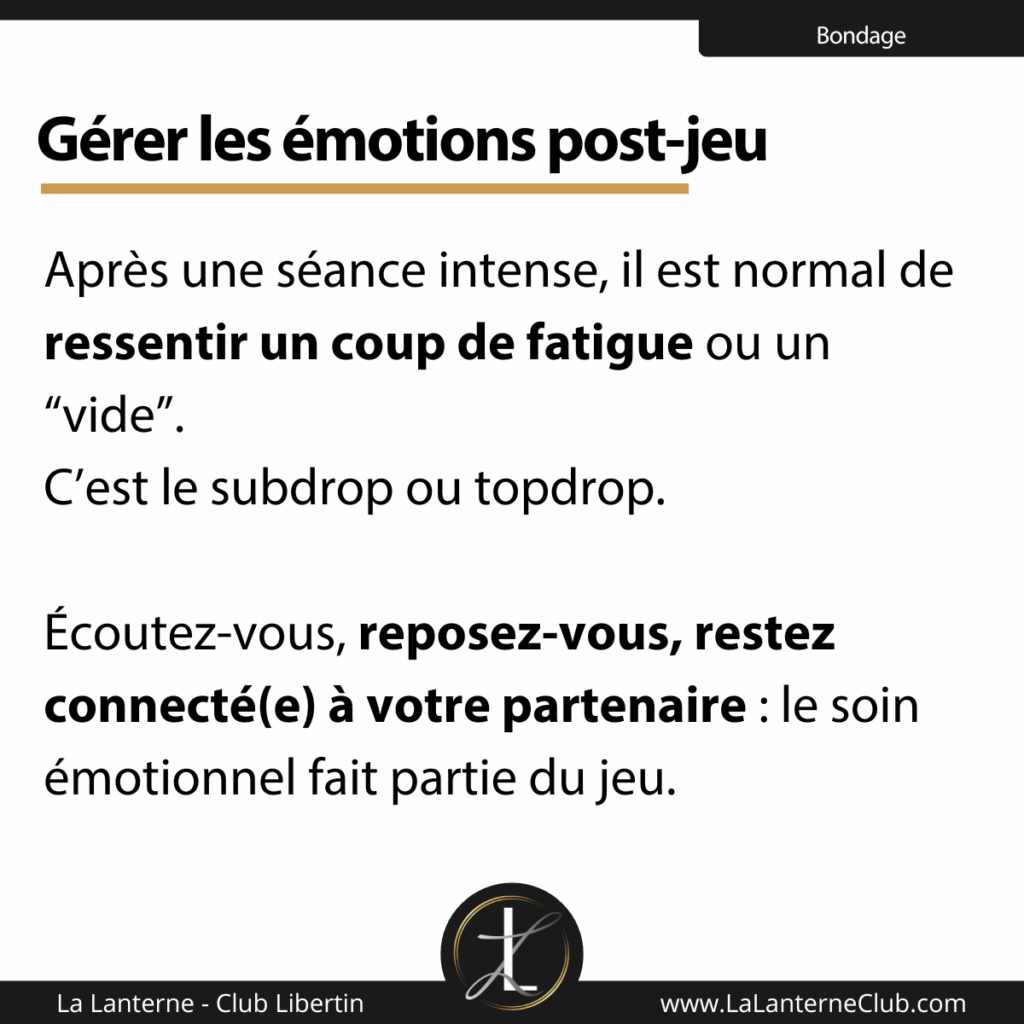
Managing emotions
After the adrenaline rush and intense immersion, you may feel a kind of "emptiness" after the session.. This is called subdrop (for the submissive) or topdrop (for the dominant).
This can mean a drop in energy, a bout of the blues or hypersensitivity. It's perfectly normal! The body and mind return to equilibrium after an emotionally powerful experience.
To better manage this descent:
- Treat yourself to a moment of relaxation and comfort.
- Stay hydrated and eat a sweet snack if you need to.
- Keep in touch with your partner, even after the session.
FAQ :
How long can you safely stay tied up?
Don't go longer than 30 minutes without checking blood circulation and comfort. Slight numbness is normal, but persistent tingling or loss of sensation requires immediate release. Take regular breaks to avoid any risk.
What's the best position for your first bondage session?
Lying on your back with your wrists and ankles tied is the ideal starting position.. It provides good control and reduces the risk of discomfort. Make sure the wearer can move slightly and communicate easily.
What are the signs of too-tight bondage?
If skin becomes white, blue or numb, release immediately.. Mild tingling may be normal, but total loss of sensation indicates a problem. Keep an eye out for deep marks after the session.