Would you like to become a true BDSM Master and embody this role with confidence and respect? All too often, a lack of solid knowledge can lead to awkward or uncomfortable experiences.
Instead, imagine a world where your skills inspire confidence and respect. We guide you step by step to develop your skills and become a true master, whether you're a novice or an initiate.

Master vs. Dominant : What's the difference?
You may be asking yourself, "What's the real difference between a Master and a Dominant?" And that's an excellent question, because these two roles, although similar, are not identical and involve very different dynamics.
- A Dominant is the one who takes control in a relationship.but often in an ad hoc setting, such as a session BDSM or a defined moment. Its role is to lead, establish rules and create a temporary dynamic of domination/submission.
- A Master, on the other hand, commits to a long-term relationship. It's not just about directing a scene, but embodying a constant authority, often with a wider responsibility towards his/her submissive partner. It's a demanding role that relies on trust, commitment and clearly defined limits.
Two roles, two approaches: one momentary, the other long-lasting. It's up to you to decide which one suits you best!
BDSM Master: Responsibilities and Missions
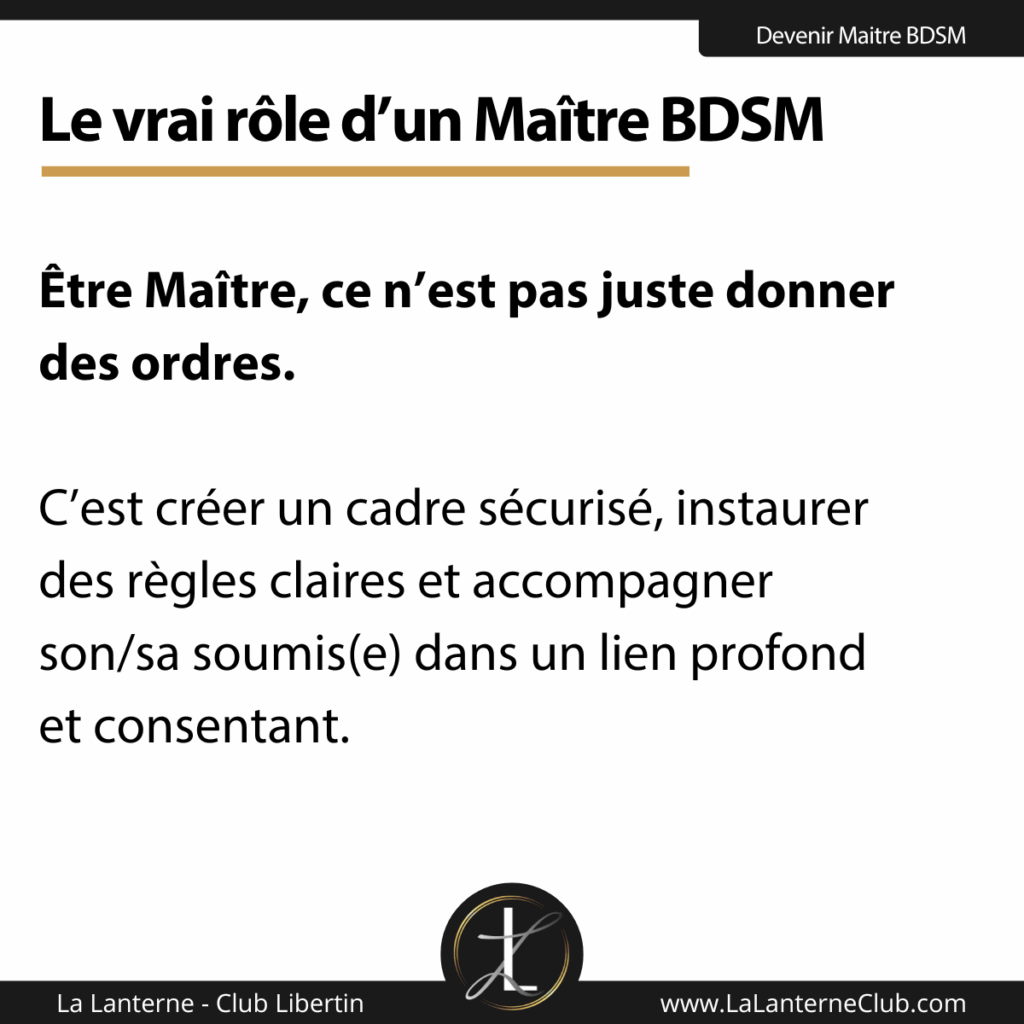
The role of the BDSM Master goes far beyond giving orders or exercising authority.. To be a Master is to embody a figure of leadership, protection and accompaniment in a relationship based on trust and consent.
Your mission as a Master is to establish a clear framework within which your submissive partner can work. can flourish. This includes defining rules, creating a safe space to explore practices, and listening attentively to each other's needs and limits. But this does not mean imposing without return: a Master must also know how to adjust, guide and reinforce this mutual trust.
In short, the Master is a pillar A responsible, respectful and committed member of the team, he leads the relationship with an assumed authority, but always with a benevolent touch.
And what is the role of the submissive?
The submissive, in a BDSM relationship, voluntarily accepts to surrender to authority. of the Master in a secure, consenting environment. His role is not passive: he actively contributes to the dynamic by respecting the rules, expressing his limits and communicating his needs.
Trust, transparency and involvement on the part of the submissive are important to create balance and strengthen the connection with the Master. It's a partnership in which each role is essential to the harmony of the relationship.
Why become a BDSM Master?
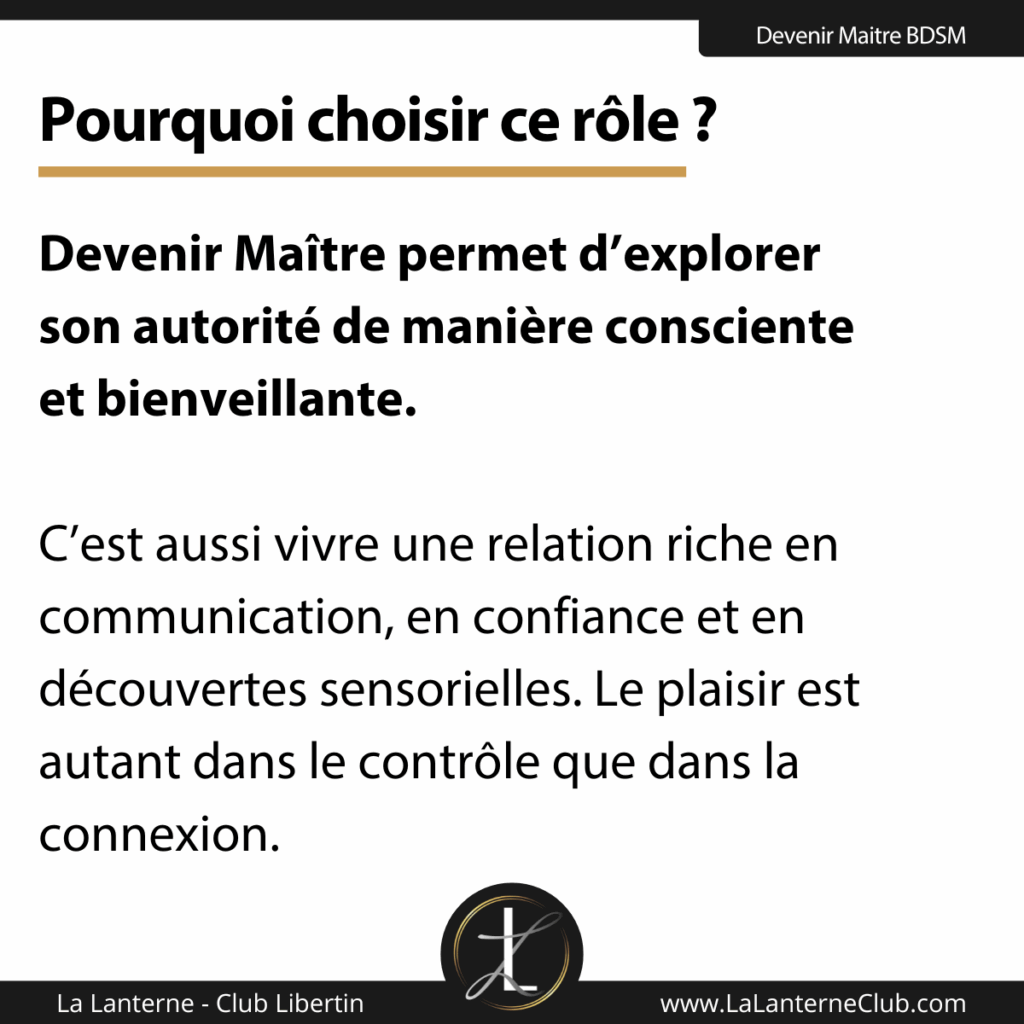
Becoming a BDSM Master is much more than assuming a role of authority: it's a personal and relational process rich in discoveries. For some, it's a way of exploring their natural leadership and assuming responsible authority. For others, it's the pleasure of guiding, teaching and building relationships based on deep trust.
Being a Master also allows you to develop a fine understanding of your submissive partner, to establish a dynamic of mutual fulfillment, and to push back the frontiers of your desires together. It's an experience where respect, commitment and exploration come together, offering a unique and authentic connection.
Qualities of a Master: What Makes the Difference
Assertiveness
A Master must know what he wants and not hesitate to say it clearly.. Your partner needs to feel he can rely on you. The more assertive you are, the more solid a foundation you lay for your role.
Self-confidence
If you doubt yourself, your partner will sense it immediately.. Self-confidence is what enables you to play your role flawlessly. And let's be honest, it's also much more attractive to have someone in front of you who knows where they're going!
Charisma and authority
A master without charisma is like a conductor without a baton. It doesn't work. Your charisma commands attention, and your natural authority inspires respect and admiration. There's no need to overdo it: your presence should speak for itself.
Communication
Yes, being a Master also means talking and listening. Saying what you expect, understanding how the other person feels, adjusting when necessary: that's the real key to a successful relationship. With good communication, everything flows more smoothly (and much more pleasantly).
Liability
You're the one who leads the dance, but with that comes great responsibility.. You must respect limits, look after your partner's well-being and always keep control of the situation. Being a Master is not a game, it's a serious role, even if it can be fun.
Respect
Without respect, there's no trust, and without trust, there's no BDSM relationship. Always respect your partner, his desires, his limits, and show him that you are worthy of his submission. That's what it's all about.
Punish fairly
Punishment doesn't mean letting off steam or act on a whim. Each sanction must be justified, proportionate and, above all, constructive. Your partner needs to understand that it's never gratuitous, but always in the best interests of the relationship.
Self-control
If you lose your footing, your role collapses. Master your actions, your words and your decisions to fully embody what it means to be a Master. It's this mastery that makes you credible and respected...
Patience
Rome wasn't built in a day, and a BDSM relationship is not built in a bondage session. Take the time to learn, adjust and let your partner evolve at his or her own pace. Patience is also proof of your respect and commitment.
Starting out as a Master: What you need to know
| ❌ Current error | ⚠ Why is this a problem? |
| Wanting to control everything right away | The role of Master cannot be improvised. Wanting to master everything immediately can damage trust and slow down the evolution of the relationship. |
| Confusing authority with abuse | A Master guides with respect, not dominates through fear. Authority must never become abuse or coercion. |
| Lack of preparation | Taking the plunge without understanding the practices, safety rules and psychology of submission is risky business. Knowledge is essential. |
| Forget the human aspect | BDSM is first and foremost a relationship between two people. Not taking into account the partner's emotions and well-being reduces the richness of the bond. |
| Not willing to question yourself | Every Master evolves with experience. Refusing to learn and ask for feedback limits your progress and that of your relationship. |
| Precipitating confidence | Trust is built up over time, it can't be decreed. Be patient and respectful so that it settles in naturally. |
| Wanting to match an image | Trying to imitate a stereotype is detrimental to your authenticity. Adapt your role to your personality to be a truly inspiring Master. |
FAQ :
Does a BDSM Master always have to be dominant in everyday life?
Not necessarily, it depends on the dynamics defined with your partner.. Some Masters reserve their authority for BDSM, while others integrate this role into their daily routine. The important thing is to respect the needs and agreements of the relationship.
Is the Master responsible for the submissive's mental well-being?
Yes, in part, because trust and emotional security are fundamental in BDSM.. This means remaining attentive to your partner's emotional reactions and interrupting a practice if necessary. Being a Master also means making sure your partner feels fulfilled in the relationship.
Can a Master have several submissives?
Yes, if all parties are willing and if you can assume these dynamics without neglecting anyone.. This requires rigorous organization and impeccable communication. Every relationship must be managed with the same respect and commitment.